

Vol. 33. Núm. 7.
Páginas 9-21 (Agosto 2026)

Capítulo 2
Diagnóstico y evaluación clínica

María José Fernández-DomínguezaFrancisco Javier Formigo CouceirobNestor Javier Sánchez Sánchezc
Doi : https://10.1016/j.fmc.2026.04.002
Opciones
Puntos para una lectura rápida

  • 1.

    Importancia de la demencia:

    • •

      Es la principal causa de discapacidad y la séptima de muerte a nivel global.

    • •

      El 75% de los casos no están diagnosticados, cifra que sube al 90% en países de ingresos bajos o medios.

    • 2.

      Diagnóstico clínico:

    • •

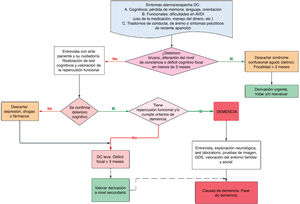
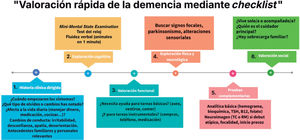
      El diagnóstico sigue siendo principalmente clínico, basado en la historia clínica, la entrevista y la exploración física.

    • •

      Es fundamental corroborar la información con un informador (familiar o cuidador).

    • 3.

      Historia clínica:

    • •

      Es el pilar del diagnóstico. Debe incluir antecedentes personales y familiares, evolución de síntomas, revisión de medicación, hábitos tóxicos y contexto sociofamiliar.

    • •

      Se exploran síntomas cognitivos, funcionales y neuropsiquiátricos.

    • 4.

      Evaluación funcional:

    • •

      Se utilizan escalas como la de Lawton y Brody (actividades instrumentales) y la de Barthel (actividades básicas).

    • •

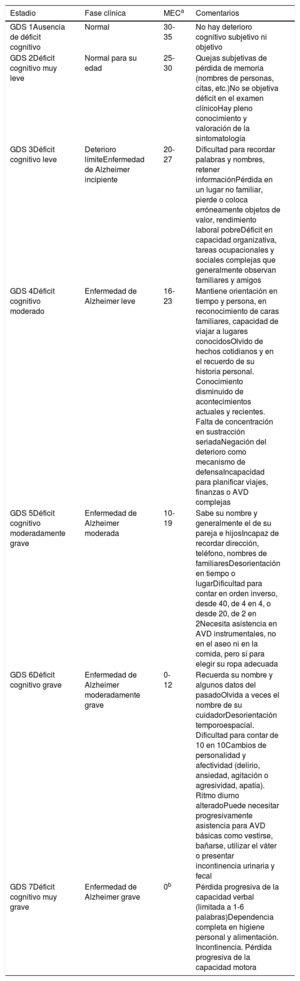
      La Escala de Deterioro Global de Reisberg ayuda a determinar el estadio de la demencia.

    • 5.

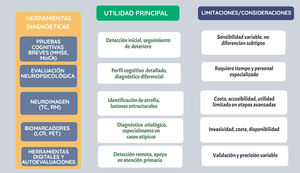
      Test cognitivos recomendados:

    • •

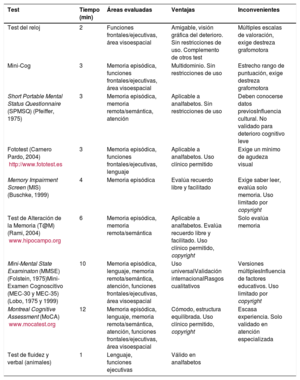
      Mini-Mental State Examination, Montreal Cognitive Assessment, Mini-Cog, Fototest, Test del reloj, entre otros.

    • •

      No existe una prueba única ni específica; la elección depende del contexto y características del paciente.

    • 6.

      Entrevista al informador:

    • •

      Mejora la precisión diagnóstica. Se recomienda usar cuestionarios como el Informant Questionnaire on Cognitive Decline in the Elderly y la escala de Zarit para evaluar la sobrecarga del cuidador.

    • 7.

      Exploración física y neurológica:

    • •

      Permite descartar causas reversibles y valorar comorbilidades.

    • •

      La neuroimagen (TC, RM) se usa para descartar lesiones estructurales o causas secundarias.

    • 8.

      Biomarcadores y neuroimagen funcional:

    • •

      No son de uso rutinario, pero pueden ser útiles en casos seleccionados o de inicio temprano.

    • •

      Incluyen PET amiloide, PET tau y FDG-PET.

    • 9.

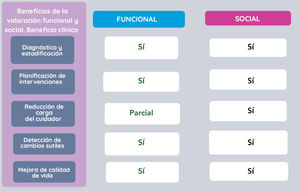
      Valoración funcional y social:

    • •

      Es clave para el diagnóstico, el pronóstico y la planificación de cuidados.

    • •

      Se recomienda evaluar la función social y familiar con escalas como OARS, Gijón y APGAR familiar.

    • 10.

      Enfoque multidisciplinar:

    • •

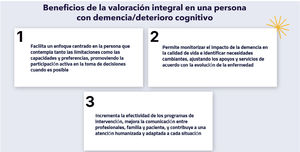
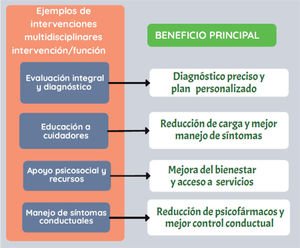
      El manejo de la demencia requiere un equipo multidisciplinar (médicos, enfermeros, trabajadores sociales, neuropsicólogos, terapeutas, etc.).

    • •

      Mejora la calidad de vida, la adherencia a guías clínicas y reduce hospitalizaciones.

    • 11.

      No se recomienda cribado en asintomáticos:

    • •

      No está indicado realizar cribado de deterioro cognitivo en mayores de 65 años asintomáticos.

    • 12.

      Seguimiento:

    • •

      Es fundamental el seguimiento periódico del paciente y del cuidador para monitorizar la evolución y ajustar el plan de cuidados.

Palabras clave
Demencia
Pruebas cognitivas
Diagnóstico precoz
Historia clínica

Identifíquese

¿Aún no es suscriptor de la revista?
Comprar el acceso al artículo

Comprando el artículo el pdf del mismo podrá ser descargado

Teléfono para incidencias

De lunes a viernes de 9h a 18h (GMT+1) excepto los meses de julio y agosto que será de 9 a 15h
Llamadas desde España 932 415 960
Llamadas desde fuera de España +34 932 415 960
Bibliografía
[1]
Manual de atención a personas mayores, semFYC,
[2]
Z. Arvanitakis, R.C. Shah, D.A. Bennett.
Diagnosis and management of dementia: Review.
JAMA., (2019), 322 pp. 1589-1599
[3]
A. Garrido Barral, M.C. Hoyos Alonso, A. Tentor Viñas.
Protocolo de diagnóstico y tratamiento del deterioro cognitivo.
[4]
M.A. Acosta Benito, R.A. García Pliego, J.M. Baena Díez, A. Gorroñogoitia Iturbe, Y. Herreros Herreros, M.C. de Hoyos Alonso, et al.
Actividades preventivas en el mayor. Actualización PAPPS 2022.
Aten Primaria., (2022), 54 pp. 102438
[5]
F. Naeem, J. McCleery, T. Hietamies, F. Ismail, S. Clinton, A. O’Mahony, et al.
Diagnostic test accuracy of self-administered cognitive assessment tools for dementia.
Cochrane Database Syst Rev., (2024), pp. CD013725
[6]
Diagnóstico diferencial de las demencias. Guías clínicas. 2021. Disponible en: www.fisterra.com/recursos_web/mbe.
[7]
A. Nous, M. vande Vyver, W. Wiels, S. Engelborghs.
Diagnostic evaluation of dementia.
Management of patients with dementia, Springer, pp. 31-55 http://dx.doi.org/10.1007/978-3-030-77904-7_3
[8]
T. König, S. Silvaieh, T. Parvizi, R. Wurm, S. Goeschl, E. Uhlik, et al.
Assessing family history and approaches for identifying dementia patients with diagnostically significant genetic findings.
Gen Med., (2025), 27 pp. 101517
[9]
A. Van Gils, A. Tolonen, A. van Harten, S. Vigneswaran, F. Barkhof, L.N.C. Visser, et al.
Computerized decision support to optimally funnel patients through the diagnostic pathway for dementia.
Alz Res Therapy., (2024), 16 pp. 256
[10]
D. Huynh, M. Patterson, B. Huang.
Clinical efficacy of a digital cognitive assessments in detecting cognitive impairments: A pooled analysis.
Innov Aging., (2024), 8 pp. 1230
[11]
F.O. Kayhan Koçak, E. Kumral.
The relationship between dementia staging scales, cognitive-behavioral scales and functionality in patients with cognitive impairment.
PLoS One., (2025), 20 pp. e0322572
[12]
S. Knox, B. Downer, A. Haas, A. Middleton, K. Ottenbacher.
Functional status associated with risk of readmission during home health care for patients with dementia.
Innov Aging., (2019), 3 pp. S823
[13]
E. Farina, R. Fioravanti, R. Pignatti, M. Alberoni, F. Mantovani, G. Manzoni, et al.
Functional living skills assessment: a standardized measure of high-order activities of dailyliving in patients with dementia.
Eur J Phys Rehabil Med., (2010), 46 pp. 73-80
[14]
S. Kraake, M. Luppa, D. Saur, J. Dietzel, J. Bach, S. Riedel-Heller, et al.
Social functioning inindividuals with Alzheimer's disease and the situation of caregivers.
J Alzheimers Dis., (2025), 105 pp. 77-89
[15]
J. Grothe, G. Schomerus, J. Dietzel, S. Riedel-Heller, S. Röhr.
Instruments to assess social functioning in individuals with dementia: A systematic review.
J Alzheimers Dis., (2021), 80 pp. 619-637
[16]
J. Grothe, M. Luppa, J. Dietzel, G. Schomerus, A. Sommerlad, S. Riedel-Heller, et al.
Psychometric evaluation of the German version of the Social Functioning in Dementia Scale (SF-DEM).
J Alzheimers Dis., (2022), 86 pp. 1231-1241
[17]
I. Blotenberg, L. Jeran, F. Rodriguez, B. Michalowsky, M. Platen, S. Teipel, et al.
The role of social support for depressive symptoms in dementia: A four-year longitudinal study.
Innov Aging., (2025), 9 pp. igaf047
[18]
J. Grand, S. Caspar, S. MacDonald.
Clinical features and multidisciplinary approaches to dementia care.
J Multidiscip Healthc., (2011), 4 pp. 125-147
[19]
J. Galvin, L. Valois, Y. Zweig.
Collaborative transdisciplinary team approach for dementia care.
Neurodegener Dis Manag., (2014), 4 pp. 455-469
[20]
M. Yamakawa, T. Kanamori, H. Fukahori, I. Sakai.
Sustainable nurse-led care for people with dementia including mild cognitive impairment and their family in an ambulatory care setting: A scoping review.
Int J Nurs Pract., (2022), 28 pp. e13008
[21]
M. Guerrero, L. Ponti, G. Sebastián, A. Lorincz.
Humanized care and challenges in the care of Alzheimer's patients.
SAP Proceedings in Interdisciplinary Insights and Innovations [Internet], (2025), 3 pp. 486
[22]
E. Jones, S. Mould, L. Ward, L. Ryan, H.P. Patel.
Integrated care for people living with dementia.
Clin Integr Care., (2022), 11 pp. 100095
[23]
C. Wolfs, A. Kessels, C. Dirksen, J. Severens, F. Verhey.
Integrated multidisciplinary diagnostic approach for dementiacare: Randomised controlled trial.
Br J Psychiatry., (2008), 192 pp. 300-305
[24]
A. Milone, Y. Hameed, T. Phiri, P. Ayodele.
Enhancing psychiatric care for older adults in a care home setting: A quality improvement project.
BJPsych Open., (2025), 11 pp. S148
[25]
H.C. Kales, L.N. Gitlin, C.G. Lyketsos.
Management of neuropsychiatric symptoms of dementia in clinical settings: Recommendations from a multidisciplinary expert panel.
Journal of the American Geriatrics Society, (2014), 62 pp. 762-769
[26]
S. Joseph, P.T. Thomas, G.S. Kumar, M. Arun, R.P. Mohandas, K. Ganga, et al.
Multidisciplinary home-based palliative care for people living with dementia: Preliminary findings on palliative care concerns and caregiver burden.
J Appl Gerontol., (2026), 45 pp. 477-488