
Puntos para una lectura rápida
- •
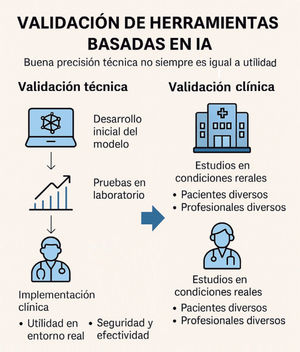
La IA debe evaluarse con el mismo rigor que cualquier intervención clínica.
- •
Una alta precisión técnica no garantiza utilidad real ni seguridad en la práctica médica.
- •
Adoptar IA de forma responsable implica entender sus beneficios, límites y riesgos éticos.
Palabras clave
Inteligencia aartificial
Seguridad del paciente
Identifíquese
¿Aún no es suscriptor de la revista?
Comprar el acceso al artículo
Comprando el artículo el pdf del mismo podrá ser descargado
Teléfono para incidencias
De lunes a viernes de 9h a 18h (GMT+1) excepto los meses de julio y agosto que será de 9 a 15h
Llamadas desde España
932 415 960
Llamadas desde fuera de España
+34 932 415 960
Bibliografía
[1]
D.J. Graham, D. Campen, R. Hui, M. Spence, C. Cheetham, G. Levy, et al.
Risk of acute myocardial infarction and sudden cardiac death in patients treated with cyclo-oxygenase 2 selective and non-selective non-steroidal anti-inflammatory drugs: Nested case-control study.
Lancet., (2005), 365 pp. 475-481
[2]
Z. Obermeyer, B. Powers, C. Vogeli, S. Mullainathan.
Dissecting racial bias in an algorithm used to manage the health of populations.
Science., (2019), 366 pp. 447-453
[3]
Duffy C. «No hay barreras de protección»: esta madre cree que un chatbot de IA es responsable del suicidio de su hijo. CNN. 2024 [citado 14 de julio de 2025]. Disponible en: https://cnnespanol.cnn.com/2024/10/30/no-barreras-proteccion-madre-latina-chatbot-ia-suicidio-hijo-trax.
[4]
E.J. Topol.
High-performance medicine: The convergence of human and artificial intelligence.
Nat Med., (2019), 25 pp. 44-56
[5]
H. Takita, D. Kabata, S.L. Walston, H. Tatekawa, K. Saito, Y. Tsujimoto, et al.
A systematic review and meta-analysis of diagnostic performance comparison between generative AI and physicians.
Npj Digit Med., (2025), 8 pp. 175
[6]
X. Liu, S. Cruz Rivera, D. Moher, M.J. Calvert, A.K. Denniston.
Reporting guidelines for clinical trial reports for interventions involving artificial intelligence: The CONSORT-AI extension.
Nat Med., (2020), 26 pp. 1364-1374
[7]
S.C. Rivera, X. Liu, A.W. Chan, A.K. Denniston, M.J. Calvert.
Guidelines for clinical trial protocols for interventions involving artificial intelligence: The SPIRIT-AI Extension.
BMJ., (2020), 370 pp. m3210
[8]
D. Plana, D.L. Shung, A.A. Grimshaw, A. Saraf, J.J.Y. Sung, B.H. Kann.
Randomized clinical trials of machine learning interventions in health care: A systematic review.
JAMA Netw Open, (2022), 5 pp. e2233946
[9]
M. Nagendran, Y. Chen, C.A. Lovejoy, A.C. Gordon, M. Komorowski, H. Harvey, et al.
Artificial intelligence versus clinicians: Systematic review of design, reporting standards, and claims of deep learning studies.
BMJ., (2020), 368 pp. m689
[10]
G. Katonai, N. Arvai, B. Mesko.
AI and primary care: Scoping review.
J Med Internet Res, (2025), 27 pp. e65950
[11]
J.G. You, R.H. Dbouk, A. Landman, D.Y. Ting, S. Dutta, J.C. Wang, et al.
Ambient documentation technology in clinician experience of documentation burden and burnout.
JAMA Netw Open, (2025), 8 pp. e2528056
[12]
J.T. Hart.
The inverse care law.
Lancet., (1971), 297 pp. 405-412
[13]
Arora RK, Wei J, Hicks RS, Bowman P, Quinonero-Candela J, Tsimpourlas F, et al. HealthBench: Evaluating large language models towards improved human health.Versión 1. Preprint arXiv, 2025. https://doi.org/10.48550/ARXIV.2502.08775.
[14]
J. Gao, D. Wang.
Quantifying the benefit of artificial intelligence for scientific research.
Nat Hum Behav., (2024), pp. 2281-2292
[15]
L. Messeri, M.J. Crockett.
Artificial intelligence and illusions of understanding in scientific research.
Nature., (2024), 627 pp. 49-58
[16]
S. Ellahham, N. Ellahham, M.C.E. Simsekler.
Application of artificial intelligence in the health care safety context: Opportunities and challenges.
Am J Med Qual., (2020), 35 pp. 341-348
[17]
R. Challen, J. Denny, M. Pitt, L. Gompels, T. Edwards, K. Tsaneva-Atanasova.
Artificial intelligence, bias and clinical safety.
BMJ Qual Saf., (2019), 28 pp. 231-237
[18]
P. Senevirathna, D.E.V. Pires, D. Capurro.
Data-driven overdiagnosis definitions: A scoping review.
J Biomed Inform., (2023), 147 pp. 104506
[19]
Kosmyna N, Hauptmann E, Yuan YT, Situ J, Liao XH, Beresnitzky AV, et al. Your brain on ChatGPT: Accumulation of cognitive debt when using an AI assistant for essay writing task. arXiv; 2025 [citado 30 Jun 2025]. Disponible en: http://arxiv.org/abs/2506.08872.
[20]
Bell M. The fundamentals of teaching. New York; 2021. 164 p.
Copyright ©
2026. Elsevier España, S.L.U. Todos los derechos reservados